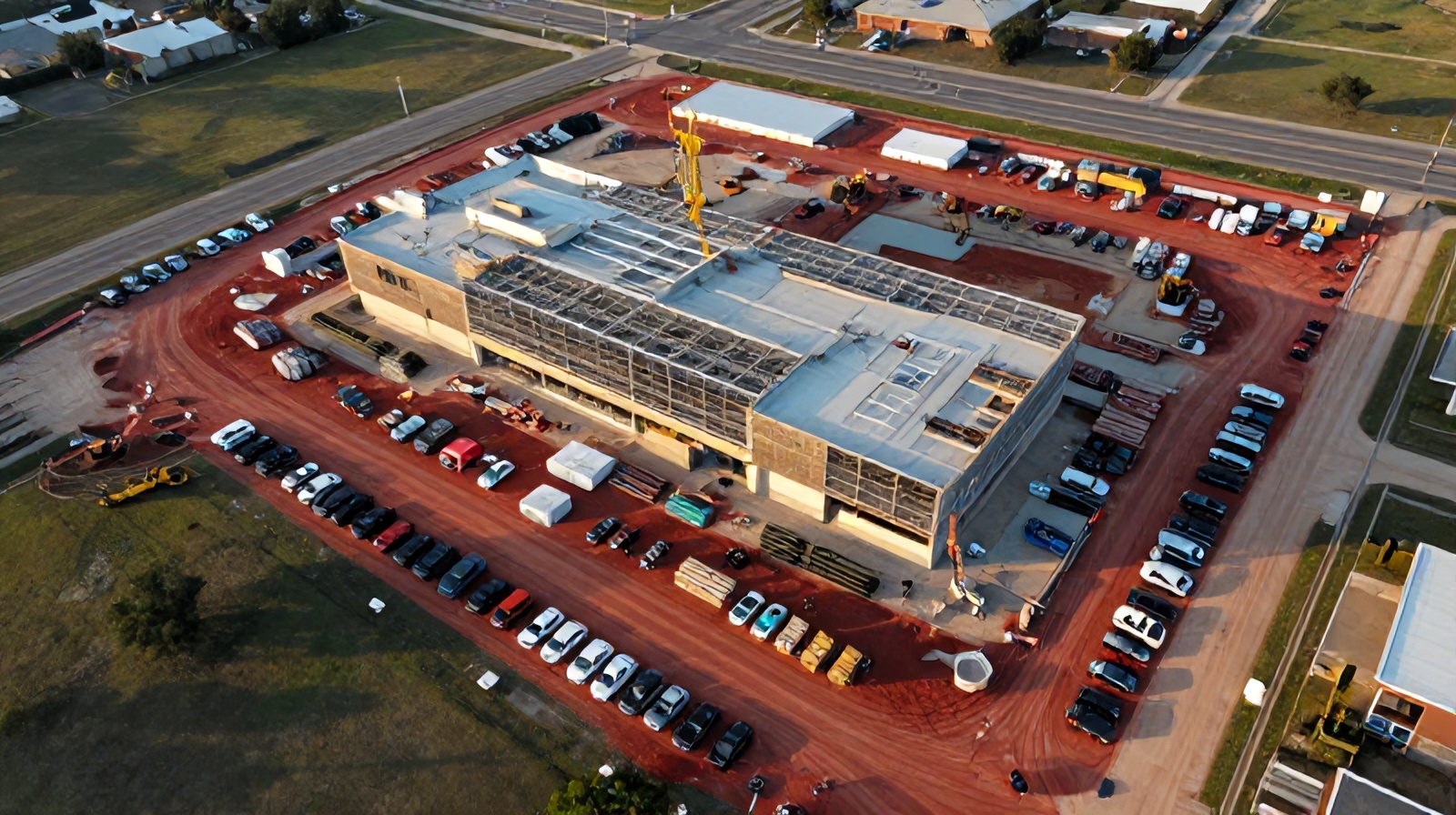
Every vendor claims their platform is "AI-powered." This guide explains specifically what that means — the algorithms, the training process, the failure modes, and how a well-built computer vision pipeline translates raw drone imagery into actionable construction intelligence.
Computer vision is not magic, not omniscient, and not a replacement for human judgment. Here's what it actually does.
Computer vision is a field of artificial intelligence concerned with teaching machines to interpret and understand visual information from the world. In the construction monitoring context, it refers specifically to the pipeline of algorithms that ingests drone imagery and produces structured outputs — object detections, semantic labels, change maps, and anomaly scores — that humans can act on.
The key insight for construction professionals is this: AI doesn't "look at" an image the way a human does. It converts an image into a numerical array (each pixel becomes a number representing brightness or color) and runs mathematical transformations — convolutions — across that array to extract patterns. Those patterns are compared against patterns learned during training, and the system assigns probabilities to different classifications: "this region has an 87% probability of containing a hard hat" or "this crack has a 94% probability of being category 3 structural spalling."
Understanding this helps calibrate expectations: computer vision is fast, systematic, and scales perfectly. It is also only as good as its training data, doesn't generalize well to conditions it wasn't trained on, and has confidence scores — not certainty. A responsible AI system in construction monitoring always presents its outputs with uncertainty quantification, not binary yes/no decisions.
Three distinct algorithm families power the different tasks in a construction monitoring AI pipeline — and each has different strengths and limitations.
Object detection models identify and localize specific objects within an image by drawing bounding boxes around them and assigning class labels. In construction, this is used to detect: workers (with or without PPE), vehicles, equipment, rebar mats, and structural elements. The dominant architecture is YOLO (You Only Look Once) and its variants — a single neural network that simultaneously predicts bounding boxes and class probabilities across the entire image in a single forward pass. This is why it's fast enough to process thousands of images per hour.
Where object detection draws a box, semantic segmentation assigns a class label to every single pixel in the image. This is more computationally expensive but captures shape information rather than just location. Used for: mapping the extent of a concrete pour, identifying the complete footprint of a water ponding area, tracing cracks across surface area, and classifying ground cover type (concrete, gravel, soil, vegetation) across an orthomosaic. Architectures include U-Net (dominant in construction/medical imaging) and DeepLabv3+.
Change detection compares two images of the same scene captured at different times to identify pixels or regions that have changed. In construction monitoring, this answers: "what work happened between last week's flight and this week's?" It can be implemented using simple pixel differencing (fast, noisy) or via deep learning-based methods (slower, more robust to lighting variation). Change detection is the core engine for progress monitoring — identifying which areas of a site have advanced and which haven't.
The quality of a computer vision model is entirely determined by the quality and quantity of its training data. Here's how that works.
Training a construction-specific AI model requires tens of thousands of labeled examples across the categories the model needs to detect. For a PPE compliance model, this means thousands of images of workers with and without hard hats, high-vis vests, and fall protection, across varying lighting, distances, camera angles, and site conditions. Images from Austin-area construction sites behave differently than images from Pacific Northwest sites — arid soil, bright sunlight, and concrete-heavy construction create distinct visual patterns that a model trained only on international data may not handle correctly.
Every training image must be labeled by human annotators who draw bounding boxes or pixel-level masks around each object of interest. Annotation quality directly determines model quality — ambiguous or inconsistent labels produce a model that behaves inconsistently in deployment. Professional annotation pipelines use inter-annotator agreement metrics (Cohen's Kappa) to validate annotation consistency before training data enters the pipeline. This is the most expensive part of building a proprietary construction AI model.
Labeled data is split into training (80%), validation (10%), and test (10%) sets. The model is trained on the training set, its performance is monitored on the validation set during training (to prevent overfitting — memorizing training data rather than learning generalizable patterns), and final performance is evaluated on the held-out test set. Training a full detection model from scratch requires GPU compute that costs $50,000–$500,000 per training run. Most construction AI uses transfer learning from foundation models (ImageNet-pretrained ResNet or EfficientDet) to dramatically reduce this cost.
Before deployment, models are tested on "hard negatives" — images designed to fool the model. For construction AI, hard negatives include: workers in unusual clothing that isn't PPE, rebar patterns in different orientations than training data, and concrete surfaces with natural color variation that might be misclassified as cracks. Models that fail hard negative testing need additional training before deployment. Failure modes are documented and disclosed to users through the confidence score reporting system.
After deployment, analyst-reviewed outputs from real projects feed back into the training pipeline. Confirmed detections and confirmed false positives become new training examples. This flywheel — more projects create more training data, creating better models, creating more accurate detection on future projects — is the compounding advantage of a managed service that processes a portfolio of projects versus a single-project deployment.
Every AI detection comes with a confidence score. Understanding what those numbers mean is essential for using AI monitoring reports correctly.
A confidence score (also called a probability score) represents the model's estimated probability that its classification is correct. A score of 0.87 for "structural crack detected" means the model believes there is an 87% probability that the flagged region contains a structural crack meeting the minimum threshold for that classification.
Confidence scores are calibrated, which means on a well-trained model, 87% confidence items should be correct approximately 87% of the time — not 100% of the time. This is intentional: a model that is always 100% confident would be poorly calibrated and actually less trustworthy than one that expresses appropriate uncertainty.
Items in this range have very high likelihood of being correct. On safety violations and structural anomalies, Ceezaer's pipeline delivers these directly to the project superintendent with recommended corrective action — analyst review is still performed but these items are considered high-priority.
Items in this range require analyst review before delivery. The item has a meaningful probability of being a true positive but also a meaningful probability of being a false positive. Analysts examine the image context, compare to the prior week's baseline, and make a binary call: confirm and deliver, or suppress as false positive.
Items below this threshold are suppressed from client reports. They may still be logged internally for model improvement purposes, but delivering low-confidence items to clients creates alert fatigue — the equivalent of a car alarm that goes off in wind: eventually everyone stops listening. A well-tuned construction AI pipeline delivers fewer alerts at higher accuracy, not more alerts at lower accuracy.
As a project accumulates flight data, the AI's confidence on site-specific patterns improves. By week 6–8 of a monitoring program, the model has built a robust baseline for that specific site, project type, and local lighting conditions — and confidence scores on true anomalies increase while false positive rates decrease.
Honest disclosure of AI limitations is a sign of a trustworthy monitoring program. Here's where computer vision reaches its boundaries in construction.
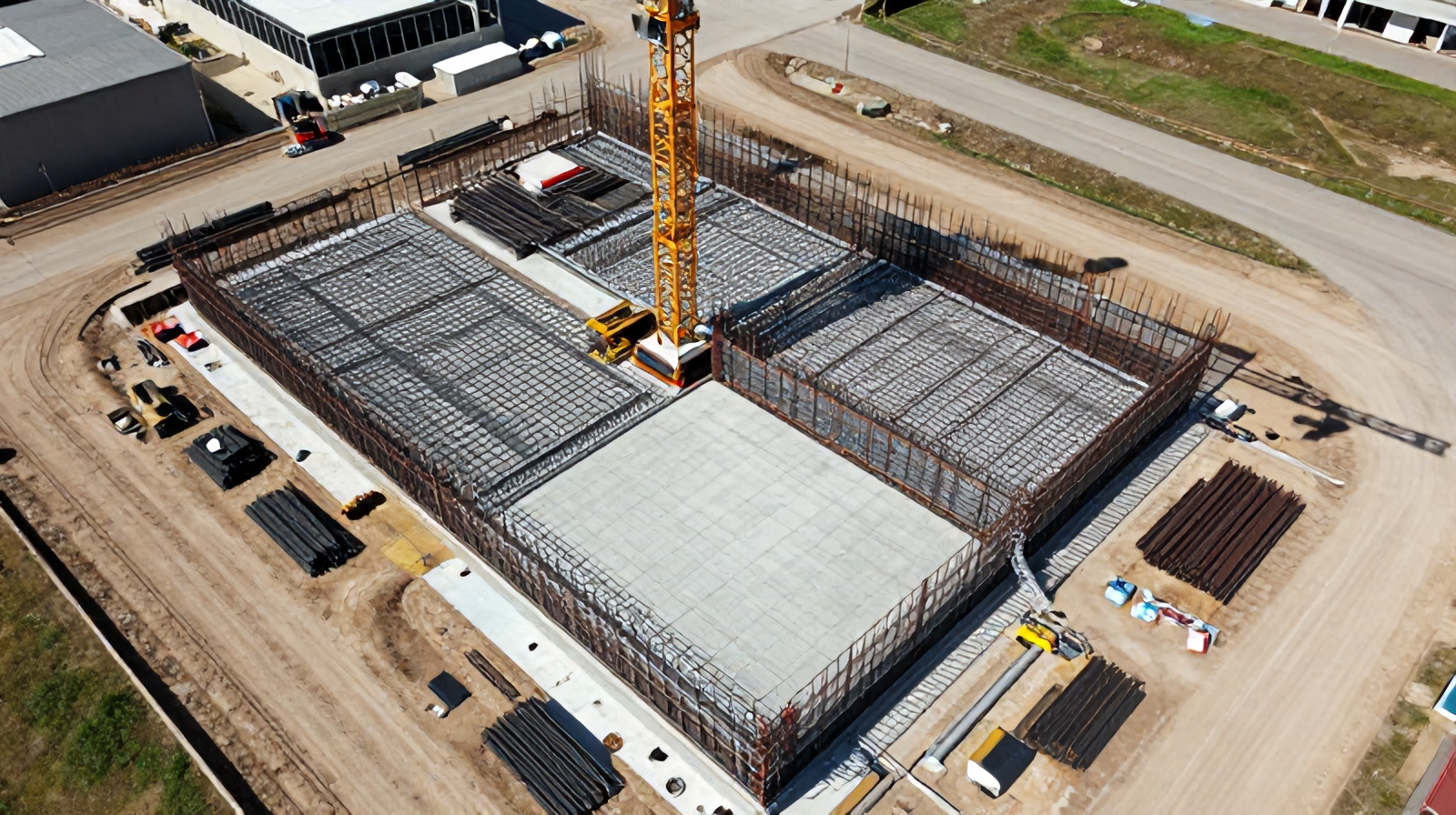
Real-world examples of what the AI pipeline catches on active construction sites — with cost-of-miss analysis.
How computer vision-derived data integrates with BIM models to compare as-built conditions against design intent.
How the same AI pipeline creates living 3D digital twins of construction projects from weekly drone captures.
How to evaluate AI quality when comparing drone analytics platforms — what to ask, what to test, what to avoid.
Upload drone imagery, get AI findings and a client-ready report in about a minute. 14-day trial, no credit card.
Analyze your first site free → See a sample report