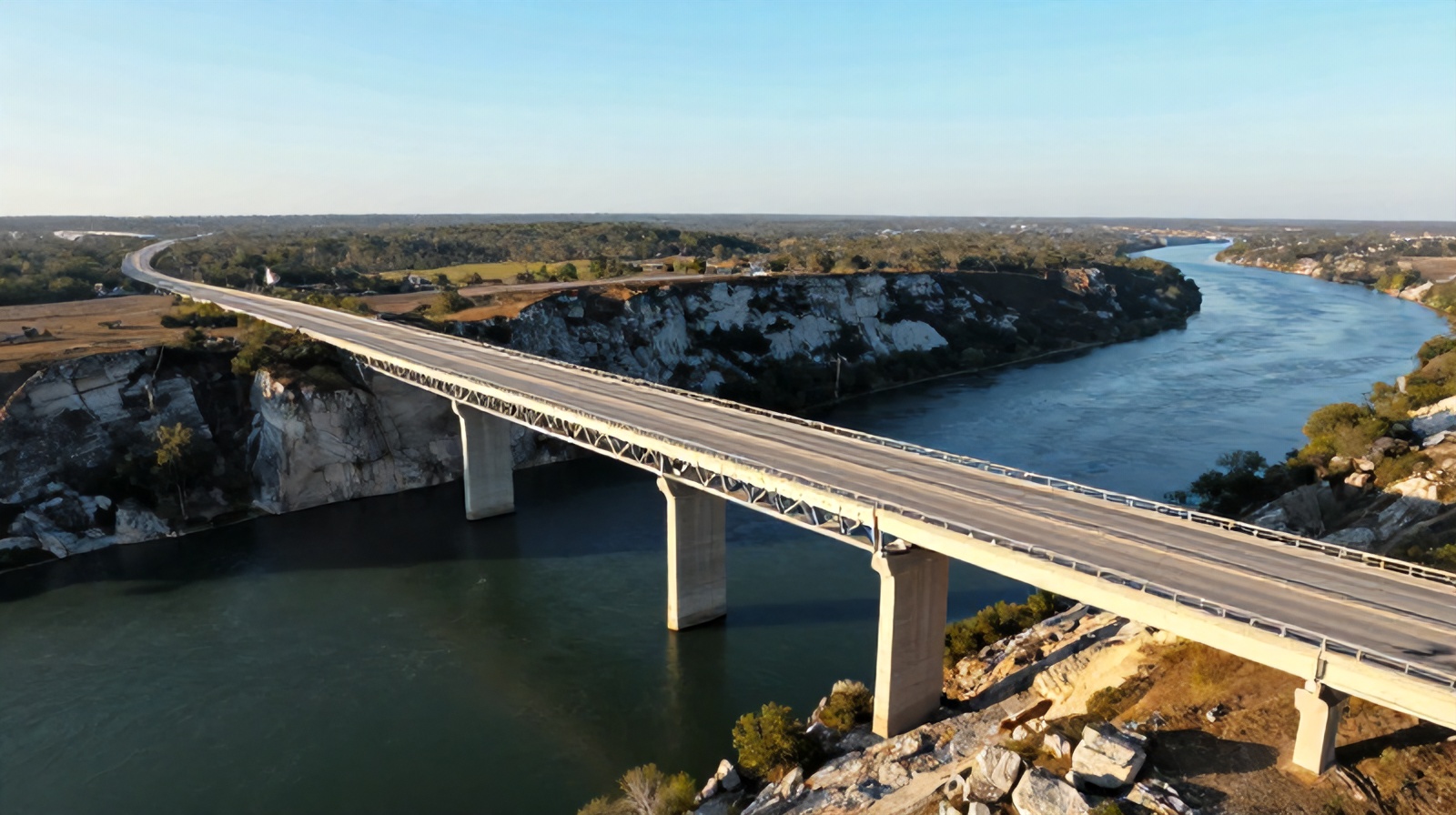
The United States has over 617,000 bridges. Texas alone manages more than 55,000. Traditional inspection methods — rope access, snooper trucks, dive teams — are expensive, slow, and dangerous. Drone inspection is changing the equation for every one of them.
Understanding what conventional inspection actually costs — in money, time, and safety risk — makes the drone alternative immediately compelling.
Federal law (23 USC 151) requires all highway bridges on public roads to be inspected at intervals not exceeding 24 months. Texas bridges must meet both federal FHWA requirements and TxDOT Bridge Inspection Program standards. For the approximately 55,000 bridges TxDOT maintains or inventories, this represents an enormous recurring inspection burden — one that conventional methods struggle to execute cost-effectively.
A standard conventional inspection of a 200-foot overpass bridge requires: a snooper truck or under-bridge inspection vehicle ($800–$1,500/day rental), a crew of 3–4 inspectors ($250–$400/hour combined labor), lane closures coordinated with TxDOT traffic control ($2,000–$8,000 per closure event), and 4–8 hours of field time for primary and underside inspection. Total cost per bridge visit: $8,000–$20,000. For a municipality managing 50 bridges on a biennial cycle, that's $400,000–$1,000,000 per inspection cycle — before factoring in the liability cost of inspector falls, which occur at a rate of approximately 1 per 10,000 inspector-hours in confined access environments.
Requires lane closure, permits, and a flat-deck site. Can't inspect box girders, pier caps below clearance height, or abutment faces. Effective on simple span overpasses but limited on complex structures.
More flexible than snooper trucks but requires certified rope access technicians, adds significant setup time, and creates significant inspector safety exposure on steel bridges over water or traffic.
Underwater inspection of substructure and pier footings is required on navigable waterways. Expensive, weather-dependent, and unable to provide photographic documentation of submerged surfaces without specialized equipment.
Used for high bridge inspections (mountain passes, long-span crossings). Effective for visual overview but expensive ($3,000–$8,000/hour), noisy, and unable to achieve close-up surface documentation without hovering near the structure.
Drones equipped with high-resolution optical and thermal cameras identify every AASHTO-classified defect category visible from the structure's surface.
High-resolution oblique imagery at 2–5 ft standoff distance captures surface spalling, delamination blisters, and honeycombing in pier columns, decks, and abutment walls. Crack width measurement is achievable down to 0.2mm at typical close-range capture altitudes. Thermal imaging detects subsurface delamination not visible optically — a critical capability for deck condition assessment.
Rust staining, pack rust at bolt connections, and surface corrosion on steel girders, trusses, and bearing assemblies are identified using high-contrast photogrammetric imagery. AI-assisted classification distinguishes between surface oxidation (NYSDOT Condition 6) and active section loss (Condition 4 and below) using trained models on thousands of labeled bridge condition examples.
Longitudinal, transverse, and diagonal cracking in concrete members indicates specific structural stress patterns. Longitudinal cracks parallel to reinforcement indicate rebar corrosion; diagonal shear cracks in beams require immediate engineering evaluation. Drone imagery captures crack location, orientation, and length with sufficient resolution for qualified inspector classification without requiring physical access.
Aerial survey of waterway bridges includes channel cross-section analysis using drone imagery and photogrammetry to detect changes in riverbank profile, pier scour pools, and sediment deposition patterns. Changes in channel geometry between annual inspections indicate active scour — the leading cause of bridge failure in flood-prone regions.
Expansion joints and bearing assemblies are high-priority inspection elements that are difficult to photograph from ground level. Drones provide direct overhead and oblique views of joint seals, joint filler conditions, and bearing pad condition — capturing evidence of settlement, rotation, or translation anomalies that indicate structural movement beyond design parameters.
Trees and vegetation growing from joints, abutment backwalls, or retaining walls create expansive pressure damage over time. Drone imagery identifies vegetation intrusion in locations inaccessible to ground observers — bearing seats, pier column interfaces, and deck drain openings where root damage compounds water infiltration damage.
Understanding how drone inspection fits within the federal and Texas regulatory framework for bridge inspection programs.
TxDOT's Bridge Inspection Program operates under FHWA's National Bridge Inspection Standards (23 CFR Part 650, Subpart C). These standards specify inspection frequency, qualifications (Team Leader must hold current NHI FHWA Bridge Inspection certification), element-level documentation requirements, and condition rating methodology (NBI Element Rating, AASHTO CoRe elements).
Drone inspection data currently serves as a supplemental documentation tool rather than a primary inspection method under federal standards — a Team Leader with physical access must still certify element condition ratings. However, drone imagery substantially reduces physical access requirements: a qualified inspector can assess element conditions from drone imagery at a ground control station, requiring physical access only for elements where drone standoff distance is insufficient to confirm condition rating.
A direct cost comparison for a typical Texas overpass bridge on a biennial inspection cycle.
Snooper truck: $1,200/day
Lane closure/traffic control: $4,500
Inspector crew (4 hrs × 3 inspectors at $85/hr): $1,020
Mobilization: $800
Report preparation: $1,500
Total: $9,020 per inspection
Drone flight (half-day): $1,200
Image processing and AI analysis: $400
Inspector review time (remote): $340 (4 hrs)
Report generation (automated): $200
Targeted physical access (spot checks only): $1,000
Total: $3,140 per inspection
Cost reduction: $5,880 per bridge per inspection
For a municipality managing 20 bridges: $117,600 saved per cycle
Lane closure elimination saves 4–8 hours of traffic disruption per bridge
Inspector safety exposure reduced by approximately 80%
Conventional inspection averages 40–80 photographs per bridge visit. Drone inspection produces 500–2,000 photographs with GPS metadata, plus an orthomosaic, point cloud, and video documentation. Long-term condition trending becomes possible with a consistent aerial photo archive across inspection cycles.
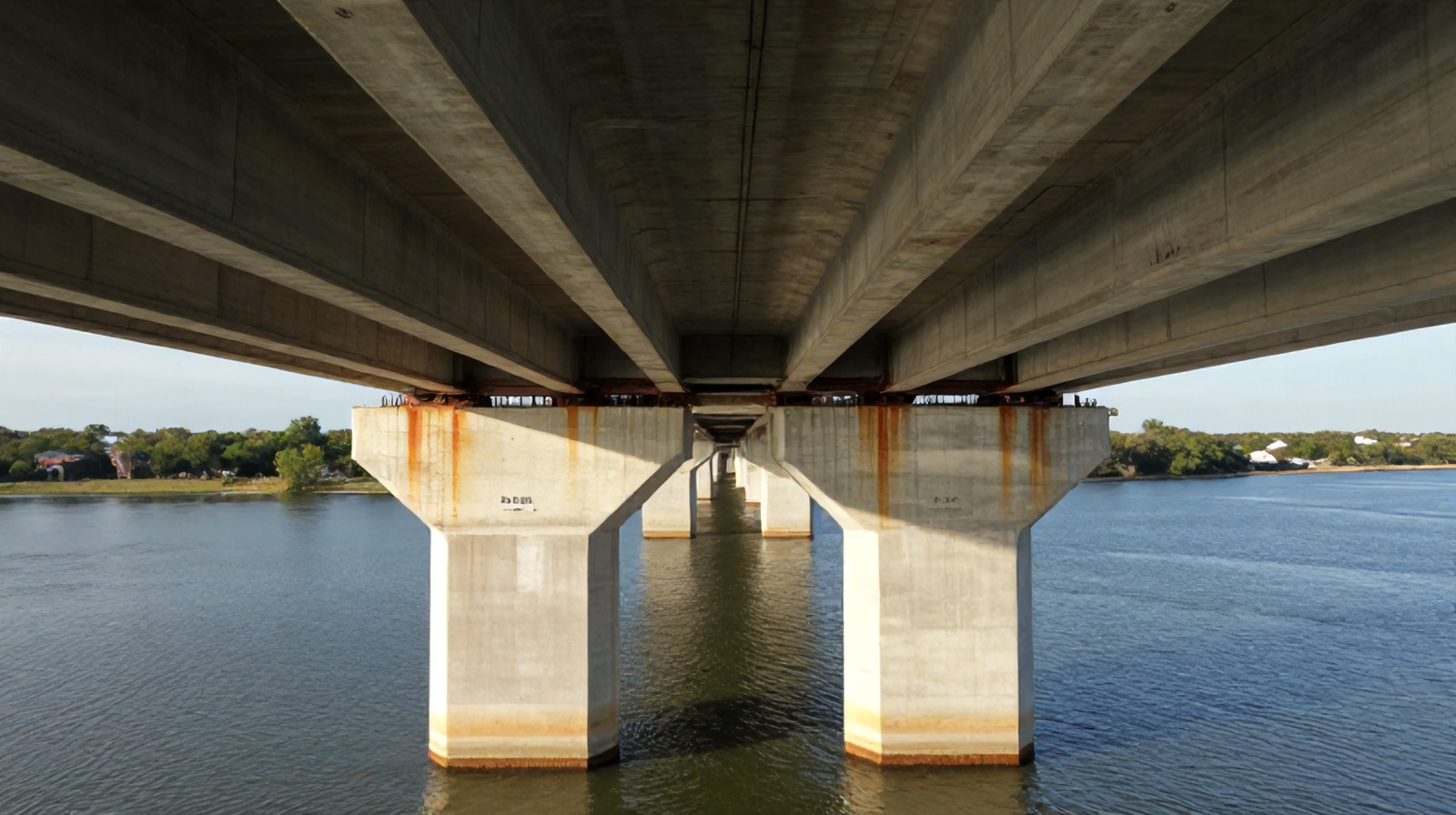
How Ceezaer applies the same aerial inspection methodology to commercial and residential roofing systems.
FAA Part 107 requirements, LAANC, and Texas-specific airspace rules for commercial drone operations.
How AI identifies structural defects, deviations, and safety hazards in drone inspection imagery.
How aerial inspection documentation accelerates insurance claims and provides defensible damage evidence.