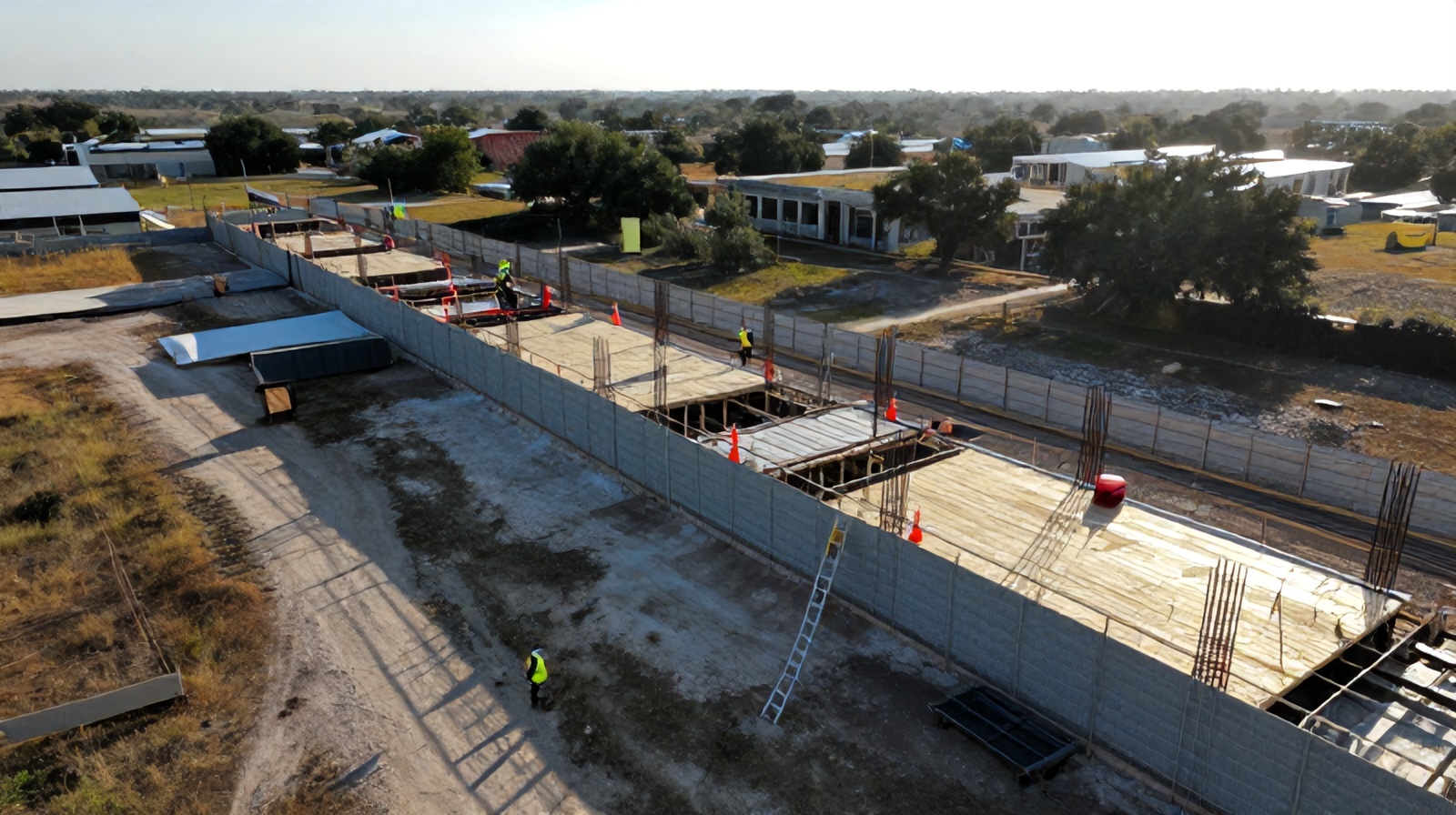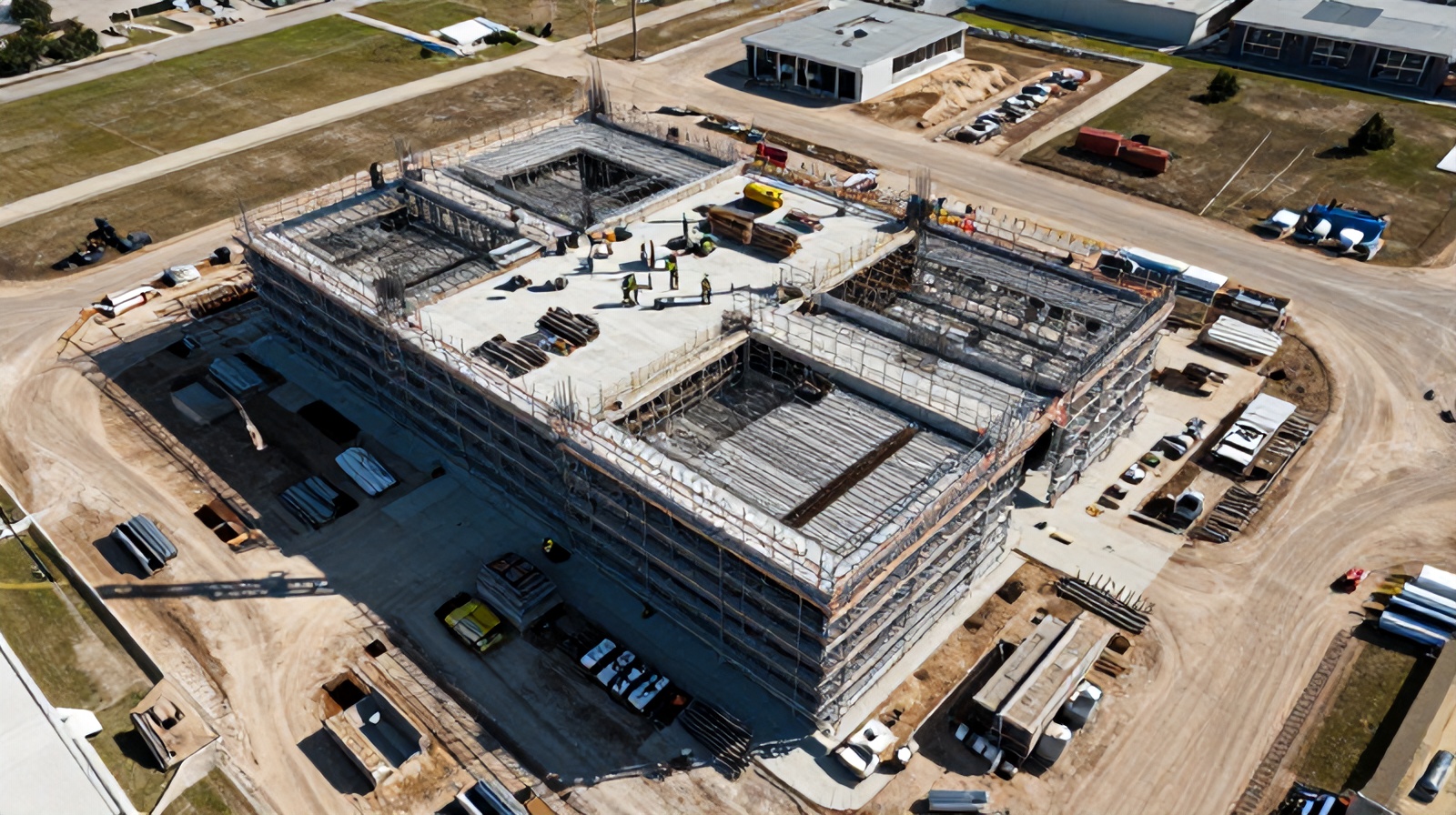
Construction remains one of the most hazardous industries in the United States — accounting for nearly 20% of all worker fatalities despite representing a fraction of total employment. Aerial monitoring doesn't just document safety compliance. Used correctly, it actively prevents the conditions that cause injuries and fatalities.
The gap between OSHA's safety standards and on-the-ground compliance is largely a coverage problem — not a knowledge problem. Aerial monitoring closes it.
OSHA requires construction employers to maintain "a competent person" on-site with authority to stop work on safety violations. In practice, one safety officer covering a 5-acre active construction site with 150 workers across multiple trades, floors, and work areas cannot maintain meaningful visual coverage of all activities simultaneously. The areas most likely to have violations — confined spaces, leading edge work, electrical installations in progress — are also most likely to be out of the safety officer's sightline at any given moment.
Aerial monitoring changes the coverage equation fundamentally. A drone in a 20-minute flight captures every accessible area of the site from above, producing timestamped, GPS-tagged photographic evidence of conditions at that specific moment. The drone does not get tired, does not get distracted, and does not skip the uncomfortable conversation with a subcontractor who is behind schedule and cutting corners on fall protection. The AI that processes the imagery does not have the interpersonal dynamics that sometimes cause safety officers to let minor violations slide to maintain relationships with valued subcontractors.
The behavioral deterrent effect alone — workers knowing that systematic aerial documentation occurs regularly — has been shown in multiple program studies to reduce observed violations by 25–40% within the first 6 weeks, independent of any direct intervention triggered by the monitoring.
These are the specific safety functions where drone monitoring delivers measurable compliance improvement on active Texas construction sites.
AI object detection models trained on OSHA-standard personal protective equipment identify workers on site without hard hats, high-visibility vests, or fall protection harnesses. Each violation is flagged with GPS coordinates, timestamp, and image evidence sufficient for OSHA citation-quality documentation. On a 150-worker site, a safety officer can observe PPE compliance for perhaps 20–30 workers during a walkthrough. A drone captures all 150 simultaneously.
Programs implementing aerial PPE monitoring consistently report 25–40% reductions in observed violations within 6 weeks, as workers understand that compliance is being documented systematically rather than spot-checked on an unpredictable schedule.
OSHA Citation Standards: 1926.100 (hard hats), 1926.102 (eye/face protection), 1926.502 (fall protection). Penalty range: $15,625 per violation up to $156,259 for willful or repeat violations.
Falls account for approximately 36% of construction worker fatalities — OSHA's number one "Fatal Four" category. Drone imagery identifies: unguarded floor openings, unprotected leading edges on elevated platforms, unsecured scaffolding planking, missing stair railings on temporary stairs, and workers on elevated surfaces without visible harness attachment points. These conditions are visible from above in a way ground-level observation often misses — a floor opening covered with a small piece of plywood draped over it looks compliant from the floor level but reveals itself as inadequately covered in overhead imagery that shows the dimensional relationship between the opening and the cover.
OSHA Citation Standard: 1926.502. Most frequently cited standard in construction — over 6,000 violations cited annually nationwide. Average penalty: $12,000+ per violation.
OSHA 1926.250 governs material storage on construction sites — stacking height limits, aisle clearance requirements, and separation of incompatible materials. Drone imagery from above provides a clear spatial view of: materials stacked beyond safe height limits, blocked egress routes, compressed gas cylinders stored horizontally or without caps near heat sources, and fuel containers in non-approved locations. The top-down perspective is ideal for these violations because the hazards are defined by spatial relationships — clearance distances, stacking geometries, proximity patterns — that are far clearer from above than from eye level among the materials themselves.
Aerial monitoring provides a dated, timestamped record of site conditions on every scheduled visit. This creates a documented safety program history that demonstrates to OSHA inspectors — in the event of an inspection or post-incident investigation — that the contractor maintained active safety monitoring at regular intervals. Without this documentation, a GC's safety program is a set of written procedures. With it, the safety program is evidenced by a dated photo record showing actual site conditions over time — a fundamentally stronger position in any OSHA enforcement proceeding or litigation arising from an incident.
When a safety incident occurs on a construction site, the first 30 minutes are critical for documentation before conditions are disturbed by first responders, OSHA investigators, or normal site activity. Deploying a drone immediately post-incident captures: exact location and position of all elements, surrounding conditions, access routes, warning signs present or absent, and the full site state at the time of investigation. This documentation is essential for OSHA root cause analysis, insurance claims, and any subsequent litigation. Post-incident aerial documentation has been cited as decisive evidence in multiple construction accident cases in Texas, both in defense of the GC and in establishing the facts of an incident for OSHA investigation purposes.
OSHA's General Duty Clause (Section 5(a)(1)) requires employers to maintain a workplace free of recognized hazards. Demonstrating compliance requires evidence of both a safety program and active enforcement. A portfolio of weekly drone safety reports — showing the same areas monitored repeatedly, violations documented when found, and corrections verified at the subsequent visit — constitutes the strongest possible evidence of an active, systematic safety program. In citation defense proceedings, this documented history consistently results in reduced penalty amounts through OSHA's Good Faith credit and Abatement credit processes, which can reduce base penalties by up to 50%.
Across a multi-month monitoring program, the safety data captured by aerial AI enables trend analysis that is impossible with manual spot-check programs: which subcontractors have persistent PPE violations across multiple visits, which areas of the site consistently generate fall hazard flags, which days of the week have measurably worse compliance patterns. This meta-level safety intelligence enables targeted interventions — additional toolbox talks with specific subcontractors, increased physical inspection frequency in persistent problem areas, scheduling changes to reduce high-risk concurrent work scenarios — rather than applying equal effort across the entire site regardless of actual risk distribution.
OSHA's "Fatal Four" account for over 60% of construction worker deaths. Here is how aerial monitoring specifically addresses each category.
Drone detection of unguarded floor openings, unprotected leading edges, unsecured scaffold planking, and workers on elevated surfaces without visible fall protection harnesses. The aerial perspective is ideal for fall hazard identification — many fall hazards are only clearly visible from above. Weekly aerial documentation ensures that newly created fall hazards (freshly opened floor areas, new elevated work platforms) are identified within days rather than surviving undetected until an injury event triggers investigation.
Aerial imagery identifies overhead power line proximity violations (OSHA 1926.1408 — crane and equipment within 20 ft of energized lines), unapproved temporary power distribution assemblies, and generators placed within hazardous distances of flammable materials. While electrical hazards often require ground-level inspection for detailed assessment, overhead imagery clearly identifies the macro-level proximity violations that precede many construction electrocution incidents before they reach the point of contact.
Overhead imagery identifies unsecured materials on elevated surfaces, overhead work areas without ground-level exclusion zones, and crane lift paths without appropriate barriers below. Tools and materials stored on elevated scaffolding or ledges are visible from above in a way they are completely invisible to workers passing below. This category is one of the most effective for aerial detection — the top-down view is uniquely suited to identifying overhead strike hazards that are definitionally invisible from ground level.
Trench and excavation compliance — sloping angles, shoring systems, and protective system requirements under OSHA 1926.652 — is visible and measurable from above. Equipment operating zones and exclusion areas around heavy equipment are identifiable in aerial imagery. While direct visual inspection by a competent person remains essential for trench safety, aerial monitoring identifies excavations that are approaching problematic depth-to-width ratios before they reach the threshold requiring protective systems.
Safety compliance monitoring is not just about moral responsibility — it has significant direct financial implications for construction firms.
OSHA can use any evidence relevant to a citation, including drone imagery, if obtained legally. However, voluntary safety monitoring programs that document violations and demonstrate correction are viewed far more favorably than sites where violations are discovered only during OSHA inspection. A documented pattern of catching violations and correcting them constitutes the Good Faith credit evidence that can reduce base penalties by up to 25%. Proactive monitoring is far less risky than having OSHA discover unmonitored violations during a programmed or complaint-driven inspection.
Under Texas law (Government Code Ch. 423) and general informed consent principles, workers should be made aware that aerial documentation occurs on the site. This is best handled through site orientation (each new worker informed at onboarding) and posted notices at site entry points. This notification is not a limitation on the monitoring program — workers who know they may be in aerial imagery are actually more likely to maintain compliance, which is the desired behavioral outcome of the program.
EMR (Experience Modification Rate) is driven by workers' compensation claim frequency and severity. A drone monitoring program does not directly reduce EMR — only fewer actual incidents do. However, by systematically identifying and correcting safety hazards before incidents occur, documented aerial monitoring programs contribute to the incident rate reduction that improves EMR over the 3-year experience period. Some Texas construction insurers are beginning to recognize aerial safety monitoring programs in underwriting assessments, providing modest premium reductions independent of current EMR calculations.
Weekly monitoring creates the strongest audit trail — demonstrating systematic attention at a frequency that can reasonably catch newly created hazards within one week of their creation. Biweekly monitoring provides a defensible program at lower cost. Monthly monitoring is insufficient for fast-moving active construction — gap periods of 3–4 weeks in the safety documentation record can be exploited in citation defense proceedings or litigation as evidence of inadequate oversight. The frequency should match the pace at which new hazard conditions can be created on your specific site.
No. OSHA requires a physically present "competent person" with authority to stop work for specific hazard categories — this cannot be fulfilled remotely or by drone. The value of aerial monitoring for OSHA compliance is in expanding coverage, creating documentation, enabling targeted deployment of the competent person's attention to highest-risk areas, and building the evidence record of a functioning safety program. It supplements but does not replace the on-site competent person requirement under any current OSHA standard.
The financial return on aerial monitoring — including OSHA penalty avoidance as a quantified value stream.
Full implementation framework — from provider selection to stakeholder reporting.
How AI identifies safety hazards, structural deviations, and compliance violations automatically.